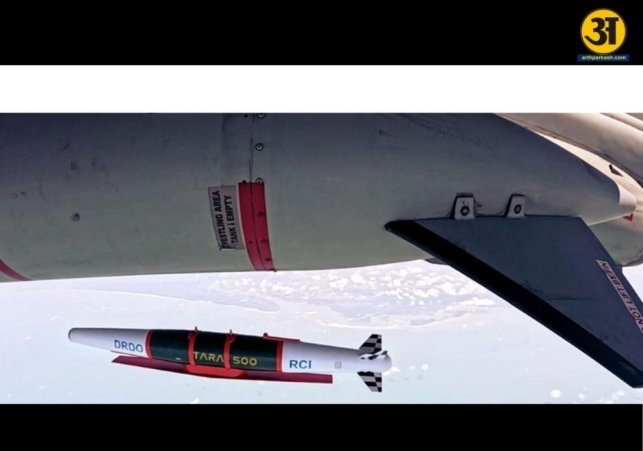
DRDO and IAF complete first successful TARA weapon trial
India successfully tests TARA glide weapon system in major defence boost
- By Gurmehar --
- Friday, 08 May, 2026
India achieved an important milestone in defence technology on Thursday after the Defence Research and Development Organisation (DRDO) and the Indian Air Force (IAF) successfully carried out the first flight trial of the Tactical Advanced Range Augmentation (TARA) weapon system. The test took place off the coast of Odisha and marked the first successful trial of India’s new indigenous glide weapon platform.
The Defence Ministry said the TARA system has been developed to improve the accuracy and strike capability of low-cost weapons used against ground targets. Officials described the successful test as a major step towards strengthening India’s self-reliance in advanced military technology.
The Tactical Advanced Range Augmentation system, also known as TARA, has been designed by Hyderabad-based Research Centre Imarat (RCI), which works under DRDO. Several other DRDO laboratories and Indian defence industry partners also took part in the project.
The successful trial comes at a time when India is focusing strongly on increasing domestic defence production and reducing dependence on imported military systems. Officials said the new system can convert ordinary unguided warheads into precision-guided weapons through a specially designed modular kit.
This technology can significantly improve the effectiveness of existing weapons while keeping costs lower compared to importing advanced systems from foreign countries.
How the TARA system works
According to the Defence Ministry, TARA is India’s first indigenous glide weapon system built with advanced low-cost technologies. A glide weapon is designed to travel longer distances after being released from an aircraft by using aerodynamic lift and guidance systems.
Traditional unguided bombs usually fall directly toward their targets after release. However, a glide weapon can travel further and strike targets more accurately. This allows aircraft to stay at safer distances during military operations.
Officials explained that the TARA system uses a modular range extension kit that can be attached to standard warheads. Once fitted, the weapon gains improved guidance and strike capability. This transforms a basic weapon into a precision-guided system capable of hitting targets more effectively.
The system is expected to improve the Indian military’s operational capability during ground attacks while also lowering costs. Defence experts believe such systems are becoming increasingly important in modern warfare because they offer high precision without requiring expensive missile platforms.
The Defence Ministry also highlighted that the project has been developed in partnership with Development cum Production Partners (DcPP) along with several Indian industries. Production activities for the system have already started, showing that the project is moving towards future deployment.
The involvement of Indian private industries is being seen as an important part of the country’s “Make in India” and “Aatmanirbhar Bharat” initiatives in the defence sector.
Major boost for India’s defence sector
Defence Minister Rajnath Singh congratulated DRDO, the Indian Air Force and industry partners after the successful test. He called the achievement a major boost for India’s indigenous defence capabilities.
According to officials, the successful maiden flight trial demonstrates the growing strength of Indian defence research and manufacturing. India has been investing heavily in advanced defence technologies over the past few years to modernise its armed forces and reduce foreign dependence.
DRDO Chairman and Secretary of the Department of Defence Research and Development, Samir V Kamat, also praised the scientists, engineers and technical teams involved in the project. He said the successful trial reflected the hard work and coordination between multiple agencies.
The Indian Air Force played a key role during the test process. Successful cooperation between the armed forces and defence scientists is considered important for the development of future military technologies.
ALSO READ: US ends ‘Operation Epic Fury’ against Iran but tensions remain high
ALSO READ: Magnitude 6 earthquake strikes Philippines, tremors felt in Samar region
India has recently accelerated efforts to build indigenous missiles, drones, aircraft systems and smart weapons. The TARA project adds another important capability to this growing list of locally developed defence platforms.
Experts say precision-guided systems are becoming essential because they improve strike accuracy while reducing collateral damage during military operations. Such systems also help armed forces operate more efficiently in difficult combat situations.
The successful TARA trial may also open opportunities for future upgrades and exports if the system performs well in additional testing phases.
India’s defence sector has witnessed rapid growth in recent years, with increasing participation from private companies and startups. The government has repeatedly stressed the importance of building advanced military technologies within the country.
The successful test of the TARA system is being viewed as a symbol of India’s expanding technological capability in defence manufacturing. It also reflects the country’s long-term goal of becoming a major global defence producer.
Officials are expected to conduct more trials and evaluations before the system is fully inducted into service. However, the maiden test itself is being seen as an encouraging achievement for Indian defence research.
With projects like TARA, India continues to strengthen its military preparedness while promoting indigenous innovation and production in the defence sector.
Related News